One of the most confusing parts of concussion recovery is this: you can be going to work, taking care of your family, getting through the day — and still feel like something is deeply wrong. You're not imagining it.
In my recent two-part conversation with neuro-occupational therapist Nate Pope, we explored a concept that completely changes how we think about persistent post-concussion symptoms: the brain is incredibly good at compensating. Sometimes, it's almost too good.
Why Symptoms Can Last Months — or Even Years
Most people are told that a concussion heals within a few weeks. But millions of people continue to experience symptoms long after their MRI comes back "normal":
- Brain fog
- Headaches
- Memory problems
- Poor concentration
- Light sensitivity
- Dizziness
- Fatigue
- Anxiety
- Difficulty multitasking
Why?
According to Nate, it isn't necessarily because the brain is permanently damaged. Instead, the brain has learned new ways of getting around the problem.
The Road Detour Analogy
One of my favorite explanations Nate gave involved road construction.
Imagine you're driving to work. Suddenly you encounter a roadblock. The road isn't destroyed — it's simply closed. So you take a detour. You still reach your destination… but it takes longer. It requires more gas. It's more stressful. You encounter more traffic.
That's remarkably similar to what may happen after a concussion.
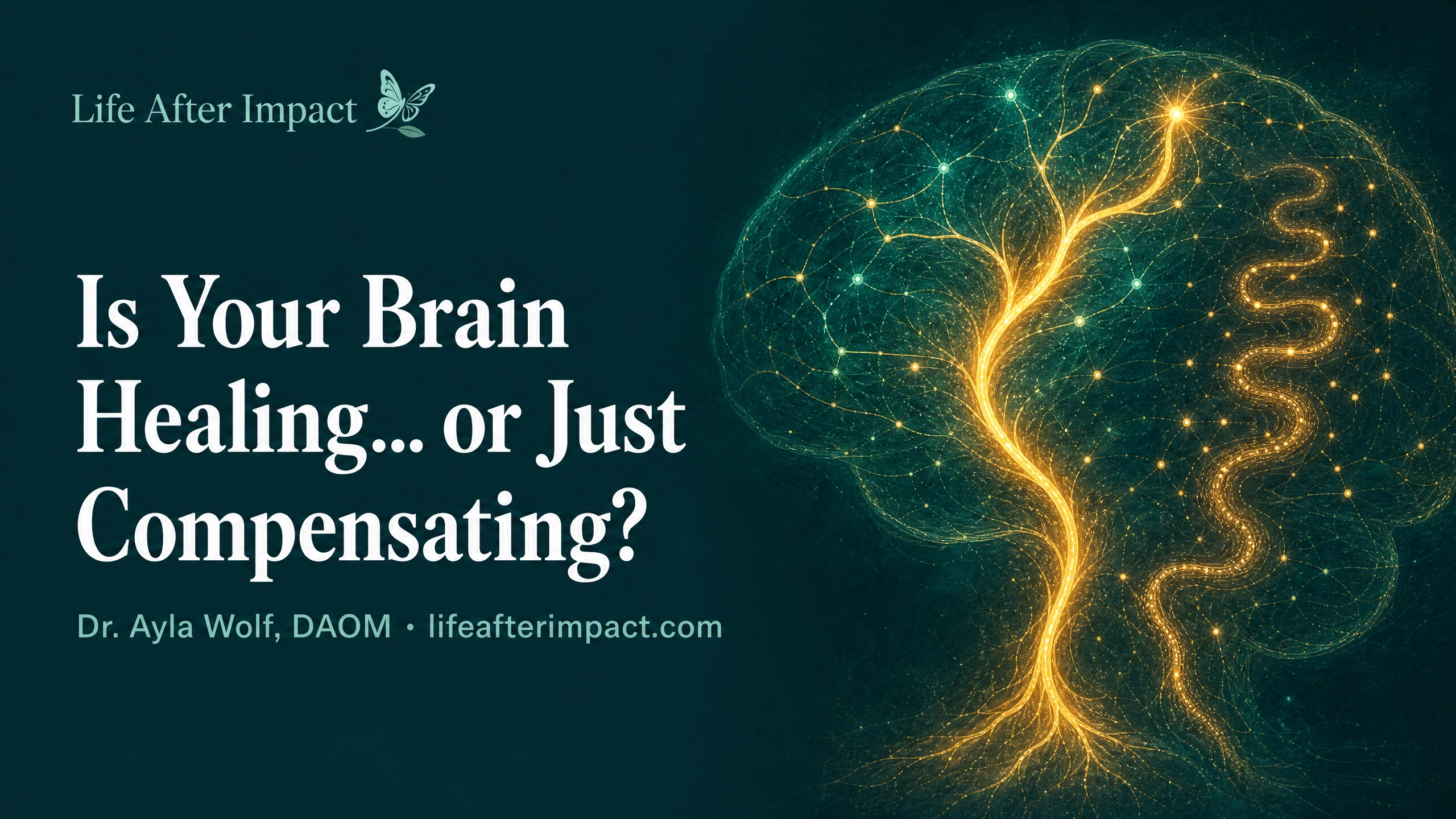
Instead of using its most efficient neural pathways, the brain begins routing information through alternate pathways that require more effort. Everything still gets done — but everything costs more energy.
Compensation Is Helpful… Until It Isn't
Initially, compensation is exactly what keeps us functioning. It's why people can often return to work, raise children, finish school, and continue living.
But if those compensatory pathways become the brain's "new normal," problems begin to appear:
- Tasks require enormous mental effort.
- Concentration becomes exhausting.
- Memory slows.
- Brain fog develops.
- Simple conversations become draining.
By the end of the day, it feels as though your brain has run a marathon.
Why Traditional Rehabilitation Sometimes Falls Short
Many concussion patients tell me they've tried everything — vision therapy, vestibular therapy, physical therapy, speech therapy, counseling — yet they're still stuck.
Nate offered an interesting explanation. When rehabilitation isolates one system — for example, vision — the brain often solves the task using the same compensatory pathways it has already developed. The exercises themselves may be excellent. But the brain keeps cheating.
"It's like revving an overheating engine. You're asking the same overworked brain networks to work even harder instead of encouraging underactive networks to re-engage."
— Nate Pope, Neuro-Occupational Therapist
Why the Whole Brain Needs to Work Together
Instead of treating one system at a time, Nate's clinic emphasizes multisensory integration. Imagine trying to do all of these at the same time:
- Maintain your balance
- Track a moving target with your eyes
- Answer questions
- Remember instructions
- Respond to changing rules
Suddenly the brain can't rely on one overdeveloped compensation strategy. It has to begin integrating multiple brain networks simultaneously. The goal isn't simply strengthening compensation — it's encouraging healthier communication across the entire brain.
Why Returning to Work Can Trigger a Relapse
Many patients work incredibly hard to improve. Their headaches diminish. Their energy returns. Their brain fog begins lifting. Then they go right back to working eight hours a day — and within weeks, the symptoms are back.
Nate sees this repeatedly. His message is simple:
"Slow is fast."
The brain needs time to practice functioning correctly before returning to the demands that originally reinforced unhealthy compensation patterns. I've seen patients make remarkable progress, only to lose much of that momentum because they were forced to resume full-time work before their nervous system was ready.
Why "Brain Breaks" Aren't Lazy
One practical strategy Nate recommends is building intentional recovery periods into the workday. Instead of pushing through worsening symptoms:
- Step away from the computer.
- Go for a short walk.
- Move your body.
- Get fresh air.
- Allow your brain to reset.
Ironically, these breaks often make people more productive, not less, because they reduce the cognitive fatigue that accumulates throughout the day.
When "ADHD" Isn't Actually ADHD
Many adults are diagnosed with ADHD for the first time after a concussion. But is it really ADHD?
Nate argues that, in many cases, it's not. True ADHD typically begins in childhood. After a concussion, problems with attention and concentration often reflect disrupted brain networks — not a new neurodevelopmental disorder.
That's an important distinction because treating the symptoms without addressing the underlying network dysfunction may not produce the results patients are hoping for.
One of My Favorite Concepts: "Avoid Avoiding"
Perhaps my favorite lesson from Nate wasn't about neuroscience. It was about psychology.
After a concussion, people naturally begin avoiding anything that makes them feel worse — bright lights, crowds, computer screens, busy stores, exercise, driving, noise. Eventually, life becomes smaller and smaller.
"You're going to avoid avoiding."
— Nate Pope
Not by overwhelming the brain. Not by pushing through severe symptoms. But by taking small, manageable steps that gradually teach the brain it can tolerate more than it believes. That philosophy aligns beautifully with modern ideas of neuroplasticity — the brain changes through appropriately graded challenge, not through complete avoidance and not through overwhelming overload.
Dr. Wolf's Perspective
One thing I loved about these conversations with Nate is that they reinforced something I explain to my patients every day: recovery isn't about forcing the brain to work harder. It's about helping the brain work more efficiently.
That may sound like a subtle difference, but it's enormous. For years, many people living with post-concussion syndrome have been told to simply "push through." Others have been told to rest indefinitely. The truth often lies somewhere in the middle.
The brain needs challenge. But it needs the right challenge — one that encourages healthy neural networks to reconnect rather than reinforcing compensatory patterns that consume more energy and leave you exhausted. That, ultimately, is what neuroplasticity is all about.
Listen to the Full Two-Part Series
In my conversations with neuro-occupational therapist Nate Pope, we dive much deeper into returning to work after concussion, multisensory rehabilitation, cognitive flexibility, functional MRI research, memory, attention, ADHD misdiagnosis, and why the brain often compensates instead of truly recovering. Whether you're recovering from a concussion yourself or caring for someone who is, these two episodes offer practical insights into why persistent symptoms develop — and, more importantly, how rehabilitation can be designed to help the brain move beyond compensation toward genuine recovery.
If you've been wondering why you're still struggling long after your concussion — even though you're “functioning” — you're not imagining it, and you're not alone. A qualified healthcare professional can help you explore what might be happening and which next steps may support genuine healing.