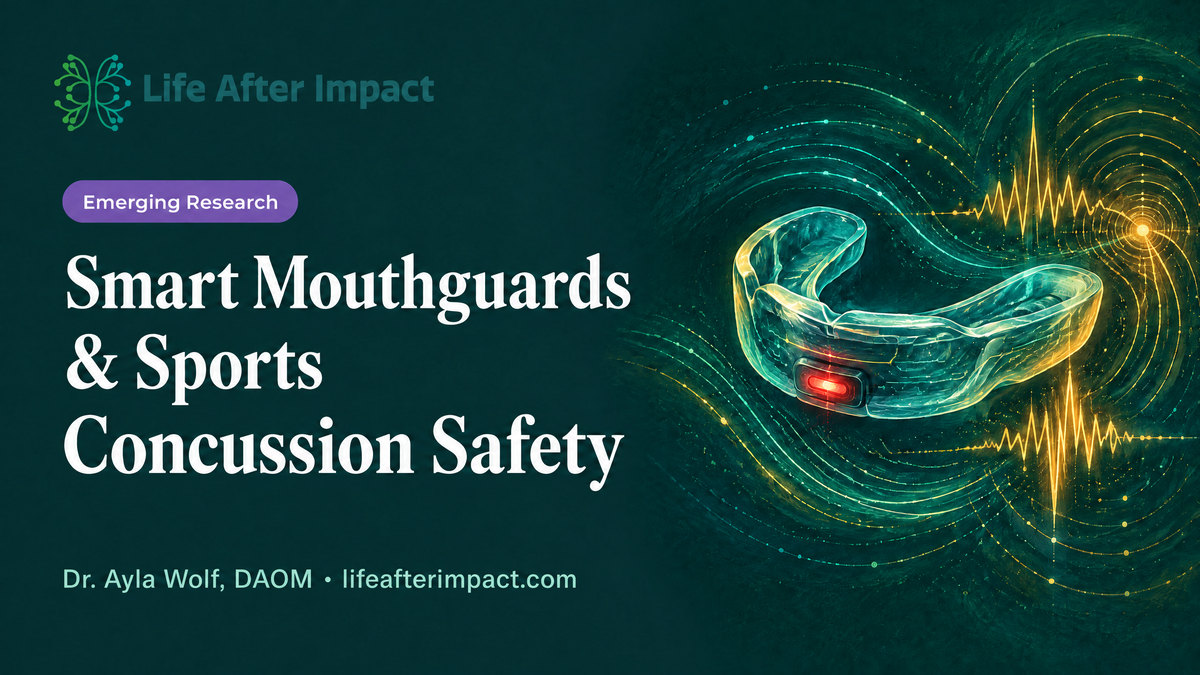
What if a mouthguard could tell coaches and medical staff that an athlete just sustained a meaningful head impact—even when nobody saw it happen? In contact sports, one of the hardest parts of concussion safety is remarkably simple: someone has to notice the hit.
An athlete may not lose consciousness, fall down, or immediately recognize that anything is wrong. They may want to stay in the game. A new generation of instrumented mouthguards—sometimes called smart mouthguards—may give sports medicine teams another way to notice an event that warrants attention.
In my conversation with longtime Pittsburgh Steelers neurosurgeon and concussion researcher Dr. Joseph Maroon, we discussed a compelling example: a mouthguard with sensors that measure forces acting on an athlete's head. When a sufficiently high head-acceleration event is detected, some systems can flash red and send an alert to the sideline. It is not a diagnosis. It is closer to a check-engine light: something important may have happened; check the athlete.
A Mouthguard That Measures the Hit
At first glance, an instrumented mouthguard can look much like an ordinary athletic mouthguard. Inside are motion sensors designed to capture head kinematics: linear acceleration, the straight-line movement of the head; rotational motion, the rapid twisting that can occur during an impact; and, depending on the system, timing, direction, and magnitude of an event.
This information can be useful for more than one dramatic collision. An athlete in football, rugby, hockey, boxing, mixed martial arts, or another contact sport may experience many impacts that never result in a diagnosed concussion. That raises a second, emerging question: not just “Did this athlete have a concussion?” but “What head-impact exposure has this athlete accumulated over time?”
Why Measure at the Mouth?
Researchers have long used sensors attached to helmets, but a helmet can move independently of the skull. It can shift, its padding can compress, and its shell can vibrate. A helmet-mounted sensor may therefore capture some combination of what happened to the helmet and what happened to the person's head.
The upper teeth offer a different opportunity. Because they are rigidly connected to the skull, a properly fitted mouthguard can move more closely with the head. A laboratory validation study of an instrumented mouthguard found strong agreement with an anthropomorphic test device for the linear and angular kinematic measurements studied. That is encouraging—but it is not a blank check. Fit matters, a device can decouple from the teeth, and real-world sport is messier than the laboratory.
The critical distinction
A flashing red alert does not mean “this athlete has a concussion.” There is no single force threshold that diagnoses concussion, and people can respond differently to similar forces. A red alert means: “A significant head-acceleration event occurred. Assess this athlete.”
From a Red Light to a Clinical Assessment
This is where the technology becomes especially relevant to safety. Some instrumented mouthguards can use an LED alert when sensors detect an event above a predefined threshold. Data may also be sent to a sideline or app-based system so that trained personnel know an athlete experienced an event that deserves a closer look.
The goal is not to replace an athletic trainer, physician, independent match-day doctor, symptom check, neurological examination, or established concussion protocol. The goal is to reduce the chance that an athlete who should be evaluated gets missed because the impact was not obvious on the field or on video.
Rugby Has Put Instrumented Mouthguards Into Its Safety System
World Rugby has incorporated smart-mouthguard alerts into its Head Injury Assessment pathway at the elite level. Its guidance describes instrumented mouthguards as a complementary objective measure alongside direct observation and video review. A high-acceleration event can help identify an athlete for off-field assessment even if symptoms were not visible and the incident was not identified by officials or cameras.
World Rugby has also published device specifications covering laboratory validation, on-field performance, and real-time reporting. That transparency matters. The organization explicitly acknowledges that this is evolving technology with limitations—not a magic answer—and requires performance testing before a device can be approved for the relevant setting.
Football Is Building a Larger Data Set, Too
The NFL launched a sensor-mouthguard research program in 2019 and later expanded its data collection through university partnerships. Its public materials describe custom-fit mouthguards collecting kinematic information such as impact speed, direction, force, location, and severity to inform injury-reduction work.
The possible use is broader than flagging one play. Large data sets may help researchers examine which positions, drills, equipment, practice structures, or player behaviors are associated with particular impact patterns. The hope is not simply to identify injuries after the fact, but to learn how unnecessary head impacts might be reduced.
One Hit Is Only Part of the Story
During our conversation, Dr. Maroon raised a larger question: could sports medicine eventually quantify an athlete's cumulative head-impact exposure more meaningfully? Medicine already uses cumulative-exposure concepts in other fields—for example, pack-years for smoking or dosimeters for occupational radiation. There is not yet a universally accepted equivalent for head impacts, but instrumented mouthguards make the question more measurable than it has been before.
That could shift the conversation from counting only diagnosed concussions to understanding an athlete's broader exposure over a practice, season, or career. It remains a research challenge, not a validated individual risk score. But it may help explain why athletes with the same number of diagnosed concussions can have very different histories of repetitive impact.
Could This Change How Teams Practice?
The most promising application may happen before an athlete develops symptoms. If a team learns that a particular drill creates an unexpectedly high number of head-acceleration events, coaches may be able to reconsider its frequency, technique, or contact structure. Teams may also be able to look for patterns in individual exposure across a week rather than assuming every athlete at a position has the same experience.
This is where smart mouthguards move from a potential alerting tool toward a source of injury-prevention research. The data alone do not tell a team what to do. It must be interpreted responsibly, alongside video, clinical expertise, training context, and the athlete's wellbeing. But it gives decision-makers information that previously was largely invisible.
What Smart Mouthguards Cannot Do
The sensor itself does not prevent concussion. It does not tell us with certainty that an athlete has a brain injury. It cannot replace medical judgment, and a low recorded event should never be used to dismiss symptoms. No one should be cleared or kept in play solely because of a device reading.
What this technology can offer is a better opportunity to pay attention. It can identify a potentially important event, capture a pattern of exposure, and help researchers ask more precise questions about linear force, rotational force, impact direction, cumulative load, and individual susceptibility.
From Guessing to Measuring
For much of sports history, head-impact exposure has been difficult to quantify. We watched the collision, asked how the athlete felt, and counted diagnosed concussions. But we could not consistently measure every meaningful force acting on the head.
A tiny sensor embedded in something athletes already wear may help change that. And in a sport where the difference between being evaluated and continuing to play can depend on whether someone noticed what happened, a red alert saying “pay attention” could be a meaningful advance in athlete safety.
Episode 79 · Listen to the full conversation
How Many Concussions Are Too Many?
In Episode 79 of Life After Impact: The Concussion Recovery Podcast, Dr. Joseph Maroon and I explore multiple concussions, repetitive head impacts, instrumented mouthguards, ImPACT testing, CTE, cumulative brain injury, and the emerging science of measuring lifetime exposure to head impacts.
Listen to Episode 79Research & further reading
These sources provide context on the promise, validation standards, and present limits of instrumented mouthguards.
This article is educational and is not a substitute for individualized medical advice, a sports-concussion evaluation, or a return-to-play decision. A mouthguard alert does not diagnose concussion, and symptoms after a head impact should be evaluated by an appropriately qualified healthcare professional following the relevant sport and local protocols.