
Back to Podcast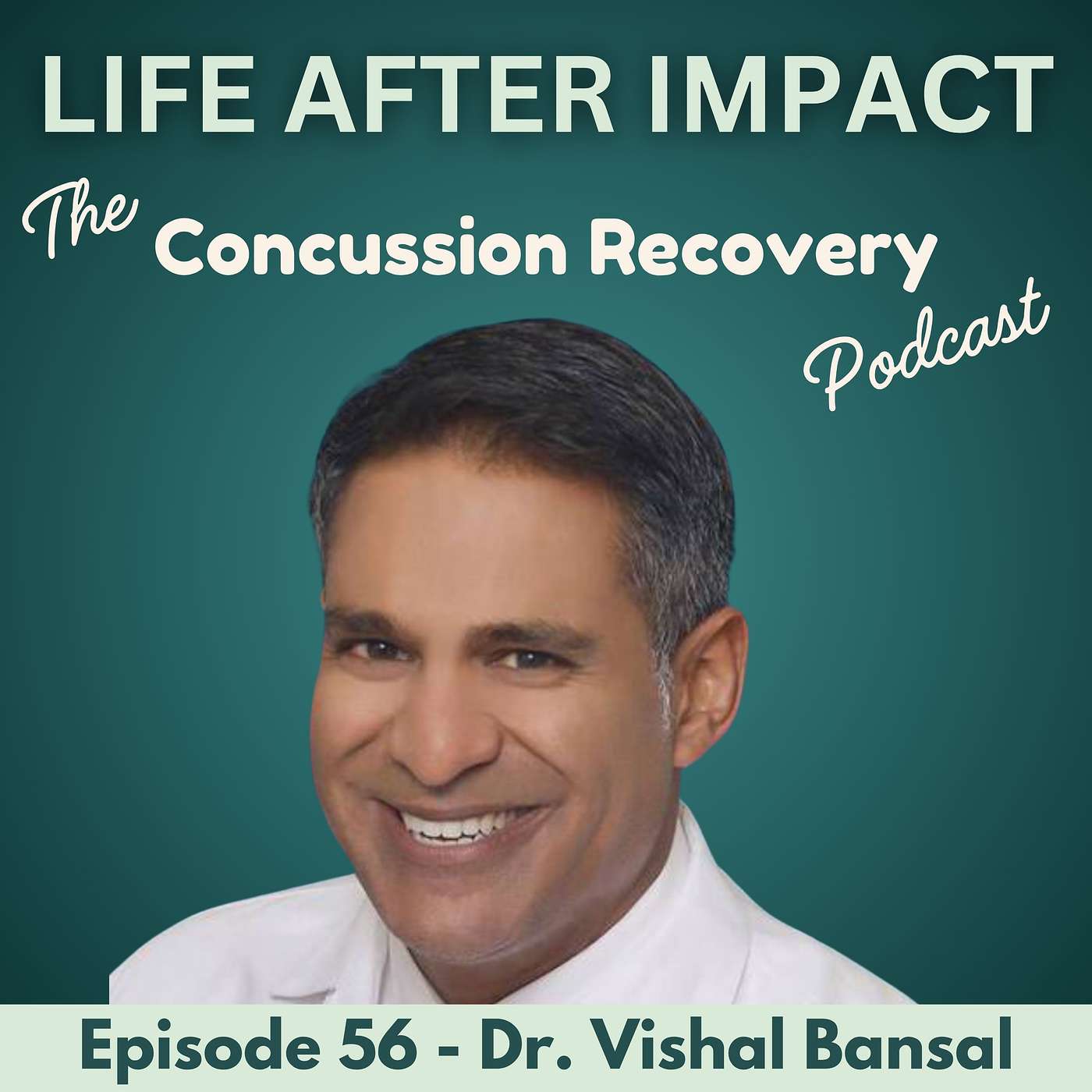
A Path to the First FDA Drug for Concussion? How Ghrelin Could Change Brain Injury Recovery with Dr. Vishal Bansal | E56
April 27, 202632m 06s
ResearchNeuroinflammation
About This Episode
Could ghrelin — a hormone best known for regulating hunger — become the first FDA-approved drug for concussion? In this episode, Dr. Ayla Wolf speaks with Dr. Vishal Bansal of Oxeia Biopharmaceuticals about the cutting-edge research exploring ghrelin's role in brain injury recovery.
Dr. Bansal shares the science behind ghrelin and the brain, the clinical trials underway, and what this could mean for the millions of people living with post-concussion syndrome and TBI who currently have no pharmaceutical options approved specifically for their condition.
Topics Covered
ResearchNeuroinflammation
Full Transcript
Dr. Vishal Bansal: 00:00
And the idea is to then prevent symptoms from developing down the road rather than treating the symptoms that are actually occurring. I think ghrelin can work in both ways because the effects that ghrelin has, hormones are pluotrophic. They have multiple effects. And one of the effects that ghrelin has on the brain is in the immediate phase, it can really restore mitochondrial health, it can decrease reaction to oxygen species. And in the longer term, it can really have a direct effect of the hippocampus and the axons. And I think that's why we can see a dual effect of ghrelin for concussions, both in the immediate period and the subimmediate period.
Dr. Ayla Wolf: 00:33
Welcome to Life After Impact, the concussion recovery podcast. I'm Dr. Ayla Wolf, and I will be hosting today's episode where we help you navigate the often confusing, frustrating, and overwhelming journey of concussion and brain injury recovery. This podcast is your go-to resource for actionable information, whether you're dealing with a recent concussion, struggling with post-concussion syndrome, or just feeling stuck in your healing process. In each episode, we dive deep into the symptoms, testing, treatments, and neurological insights that can help you move forward with clarity and confidence. We bring you leading experts in
Dr. Ayla Wolf: 01:12
the world of brain health, functional neurology, and rehabilitation to share their wisdom and strategies. So if you're feeling lost, hopeless, or like no one understands what you're going through, know that you are not alone. This podcast can be your guide and partner in recovery, helping you build a better life after impact. Dr. Vishhal Bonsal is the chief scientific officer and co-founder of Oxia Biopharmaceuticals. Since 2015, Dr. Bonsal is a director of trauma surgery at Scripps Mercy Hospital in San Diego. From 2007 until 2015, Dr. Bonsall was on faculty at the University of California, San Diego as an associate professor of surgery. Dr. Bonsall is a clinically active trauma and general surgeon as well as a funded surgical scientist focusing on the physiological response to brain injury. He has been a principal investigator of three trials in traumatic brain injury. He has nearly 100 peer review publications, book chapters, and invited reviews, sits on three national trauma committees, and is a referee for over 25 national and international scientific journals. Dr. Bonsal received his undergraduate degree in music from Kalamazoo College and his medical degree from Wayne State University, where he graduated Alpha Omega-Alpha with high honors. He completed his general surgery internship and residency at the University of Pittsburgh and his fellowship in surgical critical care at University of California, San Diego. In this episode, Dr. Bonsal walks me through his clinical thought process that led him to starting a biopharmaceutical company with the mission of clearing a path to discover what may become the first ever FDA-approved pharmaceutical for the acute treatment of concussion. Enjoy this fascinating conversation with Dr. Bonsal. Dr. Vishhal Bonsall, welcome to Life After Impact. I'm so excited to talk to you today. Thank you.
Dr. Vishal Bansal: 03:15
I am too.
Dr. Ayla Wolf: 03:16
So you are the chief trauma surgeon at Scripps Medical. And so you are working with people with severe brain injuries. And in your
Dr. Ayla Wolf: 03:25
quest to try to figure out how to give people the best outcomes, it sounds like that's taken you on quite a journey to now founding a biopharma company.
Dr. Vishal Bansal: 03:34
Yeah, that's exactly right. Um I uh it's kind of an interesting um story. My journey started. I was actually a trained general surgeon and trauma surgeon. I did my fellowship at the University of California, San Diego, um, and uh joined the faculty of UCSD as a trauma surgeon um back in about 2006. Um and um I was fortunate I had my own basic science lab. We were doing studies on brain injury and how that affected the gut. And specifically, we were taking um animal models, mice models, um, and after the brain injury of the mice models, we were looking at the intestines and looking at the intestinal permeability.
Dr. Vishal Bansal: 04:19
Really started that concept of the butt, the um uh gut-brain barrier that people are um you know really beginning to uh to discuss now at a at a several layers. But I was very interested in what happens after injury. And we notice in the clinical world, as a trauma surgeon, I have a lot of patients, the majority of my patients actually have traumatic brain injury, both mild, which are really what we call concussions to some extent, um, the moderate and severe. So that's a very core part of my practice, my clinical practice. And for the mild brain injury, we really have no treatment. Um, we just basically tell patients you have to rest, you'll get better, take Motrin as needed, um, ketanol is needed. And many of our patients, they have symptoms that last for months, sometimes even years. And I know you've seen that um in in your practice and in your um background. It's just a very common occurrence of what we see in our world. So tying it into the laboratory, um, as we're doing work in the laboratory models, um, we were noticing over and over again kind of the link between the brain and the gut really traveled through the vagus nerve. It's the tenth cranial nerve uh in the uh in the nervous system and kind of ties in the brain and the and the intestine in a manner that's um significant because not only do you have nerve roots and nerve impulses, you also have hormones that are produced in the intestines. And that can have profound impact on the brain. And I remember, geez, this was like 2012, maybe even earlier. I remember looking at this and I was trying to figure out what in the world to this connection be. Um, and you know, I was doing a deep literature dive, I was sitting at my computers in a corner office, I was looking out, looked out to another medical center,
Dr. Vishal Bansal: 06:17
part of UCSD. And I remember um this one paper where it showed that when you had an injured brain or just brain cells in general, forget an injured brain, and you stimulated with a hormone called ghrelin, those neurons regenerated. And that was my aha moment. I thought to myself, okay, that is really interesting because ghrelin, if you stimulate the vagus nerve, that helps with the gut after brain injury, and I've published that, I've shown that. If you stimulate the vagus nerve, that also increases your level of ghrelin
Dr. Vishal Bansal: 06:57
in your body. Ghrelin is a hormone mostly produced in your stomach and in your small intestine. This hormone for years, though, that's starting to change, has been considered the hunger hormone. It's a small peptide, it crosses the blood-brain barrier, very similar to GLP1s in that respect. And the effect, just like GLP1s are now used and repurposed, we thought, well, what if we took a different approach to Ghrelin, not as a hunger hormone, but what if ghrelin actually promoted brain health and was an intricate part of brain health? And furthermore, what if after injury, if we used ghrelin as a hormone, a therapeutic hormone after injury, could this in fact uh improve outcomes following injury and prevent um the uh the sequelity we see of of uh of brain injury after uh trauma?
Dr. Ayla Wolf: 07:49
This is so exciting to take something that is already a physiological loop and just say, can we upregulate this loop to have beneficial consequences? And so I love that you're taking something that the body's already producing and essentially testing a synthetic analog to say, can we upregulate this particular pathway to try to support the brain, support the regeneration of neurons, support the neuroplasticity, and help with inflammation. It's very exciting.
Dr. Vishal Bansal: 08:18
It is. And I like what you said when you said you're taking what already exists in the body. If you look at some of the most potent medicines we have um on planet Earth, and as a trauma surgeon, I have to deal a lot with um sepsis, secondary to injury, secondary to um general surgery emergencies. And we oftentimes have to use what we call vasopressor agents, epinephrine, norepinephrine, and that's produced in our body. We're just simply taking those hormones, repurposing them and putting it into a, into a much higher concentration, giving the same effects that that our body already produces. Our body produces insulin, our body produces glucine, our body produces certain types of steroids, and certainly our body produces other hormones like ghrelin. And I think that by taking what already exists, finding the different effects that that hormone can have in the body, and then amplifying that effect for a specific pathology like brain injury, I really think that's the winning ticket. And moreover, the side effect profile is minimal. And that's really important when you're talking about pharmacologic agents. You know, I as a surgeon, um, and I shouldn't say this because I'm a surgeon and a drug developer, but I'm not a big fan of medicines uh in general, because of the side effects that that medicines have. I think that the best medicines are those medicines that are used for a short-term period of time, restore your body to homeostasis, and then continue on with their life after changing whatever's uh cause now now. That can't happen for everyone, but I think in general that's the that's the kind of theme of of my own philosophy of medicine and how that can help human health. And this isn't a perfect example. So we took this hormone, we started injecting it into animals after brain injury, and the effects were remarkable. Um, there's these videos. We have them. It was kind of one of the one of those aha videos, and when people see it, they all of a sudden um uh become startled because of the effects. But after an injury, a mouse would have a hard time crossing a balance being because of the injury to the brain. When we injected the drug after the injury, a week after sustaining that injury, the mice just shoot across the balance being. I presented
Dr. Vishal Bansal: 10:36
this data at the American Surgical Association. It's one of our big surgical meetings, um, probably one of the most prestigious um uh organizations in the country for gentle surgery and American surgery. And I was lucky to have um been funded by that organization for some of this work, not all of it, but some of that. And I presented this data in front of a room full of you know the biggest academic names in surgery and the chairs of surgery across the country. And I remember L. D. Britt, um, a very prominent uh surgeon out of Norfolk, Virginia, was the president of the organization and he was next to me, and I had a very specific time. And I remember when I showed that animal on the screen, L. D. Britt goes, wow. And that's not a thing that L. D. Britt's say. So that was really at that point, I knew we had something. And um uh we took that, and here's another funny story. So, my co-founder, one of my co-founders, Kartich Shah, uh, he was in business school with my sister-in-law, and he and his wife moved to San Diego, and he was a a very experienced uh biopharma executive and and um uh in the biopharma space. And when we were just kind of discussing, um, you know, my I was just telling him the kind of research that I do, and I said, listen, you know, I got this really, and I by the way, I had no even clue that this could um go into the in the space of industry and maybe
Dr. Vishal Bansal: 12:10
be developed by myself or my team. So when we were speaking of this, and all of a sudden Cartek had this idea, you know, we should really form a company from this. Let's get a patent, let's take this. I have some friends that will be very interested in this. He brought in um one of our other co-founders, Amit Bochi, who's a very, very well-known biopharma executive with several very successful biopharma exits and and uh leadership positions. And Amit was all in it. So we had this great idea, a great team. Uh, eventually we were able to get patents. Um, we brought in Michael Wyan as our CEO. And next thing you know, it we're actually injecting this drug that I remember in the corner of my office looking out the window, and we're injecting this drug in patients with a trial that we uh collaborated with um University of Kansas. And um now we've got uh a company that's up and running. We're currently fundraising for a larger trial, and we're very excited about the future.
Dr. Ayla Wolf: 13:08
Absolutely. So, a couple of things I want to ask you. How are you figuring out what is a minimally effective dose for individual people, men versus women?
Dr. Vishal Bansal: 13:18
Sure. Um, let me get you a little bit into the weeds of of how we uh were able to achieve some of that. So it turns out that there was another company that was looking at Ghrelin um several years before we started, or not too far away, but a few years before we started. This is a Japanese company that and the actually the Japanese were the first ones to to actually quantify Ghrelin and so quote unquote discover it. So
Dr. Vishal Bansal: 13:47
this company was looking at Ghrelin for amyotrophic lateral sclerosis or ALS. And they were hoping that by injecting Ghrelin, again, they were thinking of the concept of hunger and and eating, that by doing so patients would uh get muscle mass and and have a decreased loss of muscle mass, which is something that you see in in ALS. Um, and even though they did see weight gain, what they didn't measure and what they couldn't quantify for the FDA was grip strength. So they had a whole massive package of dosing, uh, of safety. We basically accelerated our program by five years and several millions of dollars by buying their set and their package and and acquiring um their um uh grayline program. And so to answer your question, we had the dosing uh already um optimized or near optimized by the Daiichi Sanko experiments uh that were done in ALS. So that's how we were able to figure this out. And again you you mentioned dosing and why the FDA is so interested in dosing. The major reason the FDA is interested in dosing is because of side effects. They are trying to limit side effects, and therefore the thought is if you can have the minimal amount of medicine that can give you the effect you need for your drug, hopefully that'll decrease the number of side effects accordingly. It makes sense. Again, one of the nice things about Ghrelin is that the side effect profile is minimal. Some patients um feel flushed, um, they can feel very hungry, sometimes they'll have abdominal cramping because the intestines start peristals. Uh, but really outside of that, the side effect profile is minimal. So we haven't had much concern in terms of the dosing regiment as of yet.
Dr. Ayla Wolf: 15:44
In your clinical trials with people, I know you've looked at different symptom profiles, but in future larger trials, are you going to be including objective biomarkers like computerized balance?
Dr. Vishal Bansal: 15:56
Well, it's a it's an excellent question. Um it it as you well know, um having having experience in the space, it's complicated. Um, brain injury is complicated, the symptoms are complicated. Um, it's akin to neuropsychiatric disease, like depression, like anxiety. Um, those are complicated diseases. Not everyone who feels depressed feels the same way. Not everyone is anxious, who um is anxious
Dr. Vishal Bansal: 16:22
the same way. And not everyone is that is concussed is concussed the same way. So it becomes very difficult when we're talking about the different types of metrics that we measure in a clinical trial. Now, let me take what you what you asked in in two parts. The first is biomarkers. We spent a good, I would say two to three, maybe even longer, four years looking at biomarkers specifically to see if ghrelin would affect certain biomarkers that are leaked after a concussion. Um, tau protein is one of them. GFAP is another one. There's there's there's a series of biomarkers.
Dr. Ayla Wolf: 16:59
You're looking at blood blood biomarkers.
Dr. Vishal Bansal: 17:01
Correct, correct. Um the problem is with biomarkers, and when we had our first discussion with the FDA, the FDA was very specific. We don't care about biomarkers. We care about a patient's symptoms and how they're feeling. Because in the end, if a biomarker goes up, if it goes down and a patient feels the same way, it's almost irrelevant. And so the FDA, because unlike cancers and unlike other um types of like an infectious disease process, uh, the biomarkers themselves aren't necessarily a surrogate to symptoms. And so that was important for the FDA. They said all we really want to see are symptoms and not simply pain. And so that's what's so neat about the SCAT scoring and the concussion, um, the the different concussion scales that are out there. We have several symptoms, 23 to 24 symptoms. Uh, and we measure each one of them. And it's it is subjective. It's a it's a it's a um it's a survey that patients take, just like they take for for any other SCAT survey for before um season for youth sports or even collegiate sports, exactly the same type of survey outside of the cognitive stuff. And then patients then mark if they're feeling better or not according to symptoms. Now you mentioned balance. That's a great one. We actually talked about balance a great deal, and I actually think that's probably a big one that's not directly part of what we're measuring now, that very well could be something that we measure in the future, that in very specific cognitive details as well. So um the and and as you know, in the world of physiotry, balance there's a battery of different tests up there for balance. And we're a little unclear what the best tests are to use for that. That's absolutely something that we're gonna use in the future.
Dr. Ayla Wolf: 18:46
Yeah, fantastic. And so then you also have to essentially show the FDA that this isn't just treating a symptom because then you might end up with a nausea drug or a headache drug. You have to show them that this is actually treating the act injury to the brain and essentially show that it is reducing the entire symptomatology in all different domains, correct?
Dr. Vishal Bansal: 19:09
I I that's a that's a very accurate statement to say. Um they didn't give us an exact number of how many symptoms we need. Uh, we do have to show them a conglomerate of symptoms. We saw uh in our first initial trial, we saw a good movement, about four to five symptoms. Sleep was a big one, memory was a big one, irritability was a big one. So we do have very specific symptoms that are seen to be moving more with the drug than others. And I think if we present that to the FDA in a quantified manner with a good large randomized trial, I think that'll move the needle for us.
Dr. Ayla Wolf: 19:46
And are you hoping that this drug gets approved for both the acute stage after a concussion, but also for people with persistent symptoms beyond, say, three months? Or are you trying to just focus on a time point?
Dr. Vishal Bansal: 19:58
Great question. Right now we're focusing on, I would call chronic symptoms within 30 days after a concussion. Um it doesn't have to be three months, but within that kind of 30-day window would be ideal. However, interestingly, I've always been on the thought process that the earlier you get the drug, the better. Almost like an epiped. So if we think of an epiped for concussion, if we're thinking of spores, for instance, you're
Dr. Vishal Bansal: 20:24
on the sideline, a patient gets injured, clearly has a concussion. Wouldn't it be great to just break out the epiped and give a dose immediately? And the idea is to then prevent symptoms from developing down the road rather than treating the symptoms that are actually occurring. I think ghrelin can work in both ways because the effects that ghrelin has, hormones are plotrophic, they have multiple effects. And one of the effects that ghrelin has on the brain is in the immediate phase, it can really restore mitochondrial health, it can decrease reaction and oxygen species, and in the longer term, um, it can really have a direct effect of the hippocampus and the axons. And I think that's why we can see a dual effect of ghrelin for concussions, both in the immediate period and the subimmediate period.
Dr. Ayla Wolf: 21:07
I think there's a lot more emphasis on mitochondrial disorders when it comes to brain injuries. And so the fact that you are finding that ghrelin actually improves mitochondrial function could then also open the door for looking at its use in all kinds of mitochondrial disorders from long COVID to other types of issues with Alzheimer's. So I think that um it's funny how we learn about a molecule and say, oh, that's just the hunger molecule. And then you realize, oh my gosh, no, there's so much more to this.
Dr. Vishal Bansal: 21:38
I I think that's exactly right. And and and I actually think that what what I always thought of Grayland, yes, it's a rixogenic in the sense that it causes hunger, but I actually think it's a potent memory molecule. That's the way I look at it. And and I always like to try to tie this in with evolution in human existence, and and well, forget humans, mammals. In in mammalian existence, um, most mammals were always hungry, always looking for food, always hungry, had higher levels of ghrelin in the body because they were always hungry. Um and if you think about how we as humans have this innate memory associated with taste, food, and smell, it's pretty powerful. And I think that's because of the molecular grayline, that when you are hungry and you find a fruit on in a as a hunter-gatherer, or you find where a where uh an animal was as a hunter-gatherer, that then sears that process and that memory
Dr. Vishal Bansal: 22:41
in your body. And so when you experience that again, or you're having that hunger again, that'll trigger that memory. And and I think one of the the one of the most impactful examples of that that I've seen was actually in that Disney movie, Ratatouille. And and and you might remember that the the movie is based off of this rat that's cooking, you know, and and is a gifted chef. And they're they're um trying to oppress this food critic who's coming into the restaurant.
Dr. Vishal Bansal: 23:13
And so the rat makes ratatouille. And in the scene, when the food critic eats that ratatouille, I don't know if you remember this, but all of a sudden he goes back to when he was a child. When he was uh coming off his bike, he's coming home, he's tired, he's soaking wet, and his mother gives him this plate of ratatouille, and that is ghrelin. It triggered that response, that hippocampal response, which is innately sensitive with Ghrelin, innately sensitive TBI, and very, very important for memory. That's the cycle, and that's exactly what we're what we're doing. We are leveraging the biochemical effects of ghrelin, the biochemical effects of money, um, excuse me, memory and brain health, and how that affects the brain directly, and that's what we're triggering.
Dr. Ayla Wolf: 24:01
Yeah, yeah, that's beautiful.
Dr. Vishal Bansal: 24:03
I think we've all felt we've all had these memories associated with food, right? You eat something and it takes it back to when you were a child, or it takes it back to 20 years ago, or it takes it back to a a time when you're traveling. That memory is absolutely associated with um food and the longing of food. And and and and and Graylon has a role here, there's no doubt about it. Uh, and and that's what the body does. Um, and so it it I I think when you think about it in those terms, it just all spits together. And it makes complete sense that if you're taking the effect of a potent molecule that can affect memory and brain health, and you use it in a situation when the brain is not healthy and the brain is recovering, uh, the effects are pretty dramatic.
Dr. Ayla Wolf: 24:51
And where are you at currently with your next phase in the clinical trials?
Dr. Vishal Bansal: 24:56
Sure. So we are currently um in in a we're actually crowdfunding uh because we're finding that to be very effective for us. There's a company that many people have probably heard of called Start Engine, and they help companies like ours uh raise money. So if you go to startengine.com uh and you put in concussion or you put in our company, Oxia, O X EIA, then you'll be sent to a link where you can invest um uh into our company. So we're currently crowdfunding. We have um already conducted a phase 2A trial that we published in Neurotron reports last year. And we are currently trying to launch an FDA endpoint study uh with the money that we're raising through Start Engine. And in doing so, we will then be on the next phase to um then uh conduct a large phase 2B trial, almost a phase three trial, which is really at that point getting ready to present to the FDA for approval. So we're we're pretty close. Um, you know, we we get over the hump of a couple of these trials, and the next thing you know it, we'll be able to have uh uh approved safety and an approved drug ready for concussions. First ever in this class for the for the world.
Dr. Ayla Wolf: 26:11
Yeah, fantastic. Well, I can absolutely put the the start engine link in the show notes if people are interested in helping out with the crowdfunding. Is there a minimum entry point for that?
Dr. Vishal Bansal: 26:21
No, I think I think start engine has a minimum, but it's it's it's it's not much. Three four hundred dollars,
Dr. Vishal Bansal: 26:26
I think, is what it is. But there's uh we actually the we we were oversubscribed in the first round. It went by very quickly and very fast. And so we've opened the second round. And so it's been it's been great. The um the public gets it. Just about everyone I speak with is a trauma surgeon. And when they I get to know them more and they find out what I'm doing, they get very excited. How what when is this coming out? What can I do? What can I help? How can I invest? And this is exactly how how you can be part of it. We're lucky to have some some really powerful names of the NFL to be part of the company as well. And um Alec Smith being one of them, who had a very famous concussion when he played for the San Francisco 49ers, um, actually caused him to be uh benched and and Colin Kaepernick then took his spot. Very kind of famous story. So he's he's been in involved in the company um and is on the on the board as well, and um, it's been a real voice for us. And we uh we really hope that we uh we can change the change the narrative here.
Dr. Ayla Wolf: 27:23
Absolutely. Well, I mean, doctors want to help people, and when it comes to concussions, I think a lot of them feel like their tool bag is limited. And so to be able to have a really valuable tool in your tool bag with the research behind it that says this is going to minimize people's ex uh symptom burden and help them heal faster, I think that so many doctors and physicians and clinicians would be just very excited about that.
Dr. Vishal Bansal: 27:47
Yeah, we agree.
Dr. Ayla Wolf: 27:50
Amazing. Well, thank you for your time. Is there anything else that we didn't talk about?
Dr. Vishal Bansal: 27:54
Something else that I should have asked you that I didn't didn't No, I I I just hope that I'm really, I'm really excited and happy that you've taken interest in this and us in general. Um, if you have any questions or your audience has any questions, or anyone in your um network has questions, please feel free to email us and email me. Um I'd love to love to talk about this. I'd love to get the word out. We really think that we're on to something here, and we really hope we can affect human health.
Dr. Ayla Wolf: 28:24
Yes, I think so too. Medical disclaimer. This video or podcast is for general informational purposes only and does not constitute the practice of medicine or other professional healthcare services, including the giving of medical advice. No doctor-patient relationship is formed. The use of this information and materials included is at the user's own risk. The content of this video or podcast is not intended to be a substitute for medical advice, diagnosis, or treatment, and consumers of this information should seek the advice of a medical professional for any and all health related issues. A link to our full medical disclaimer is available in the notes.